
CLW / Blog
Water Bowser Capacity Guide: How Much Road Can One Tank Cover?
Calculate road coverage per tank, plan refill cycles and compare water bowser sizes for county, construction and mine work.
Quick answer
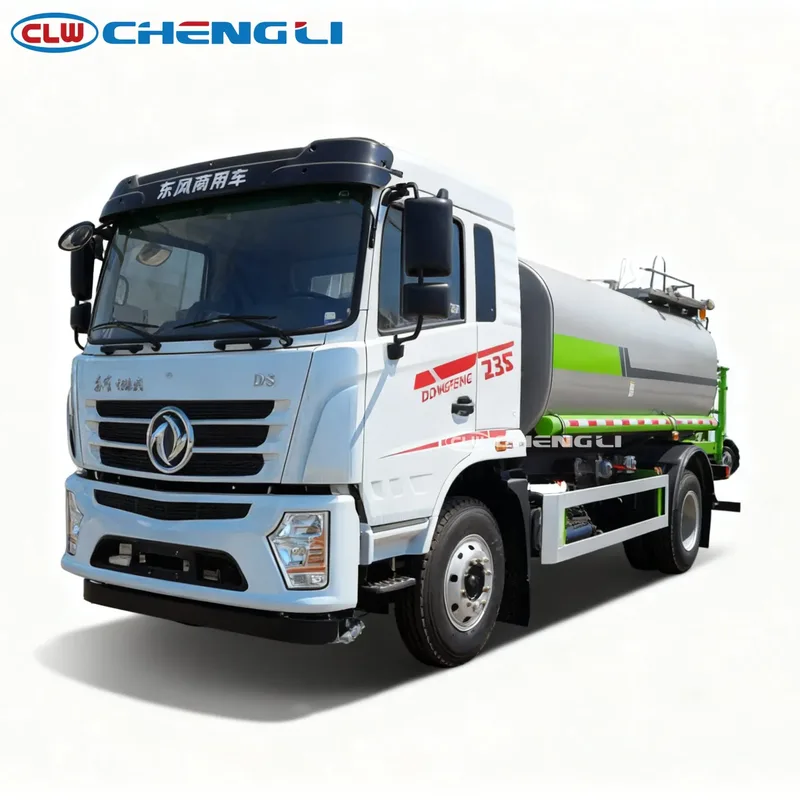
Our water bowsers range from 5,000 to 20,000 litres. A 10,000 L tank covers about 0.7 km at 1 L/m² or 1.4 km at 0.5 L/m² in the example below.
Capacity alone does not determine daily output. A county fleet in Kenya, a road contractor in Tanzania and a mine operator may use similar tanks but spend very different amounts of time refilling. Start with road width, the water required per pass and the distance to a reliable water point.
How much road can one tank cover?
Use this calculation for one spray pass:
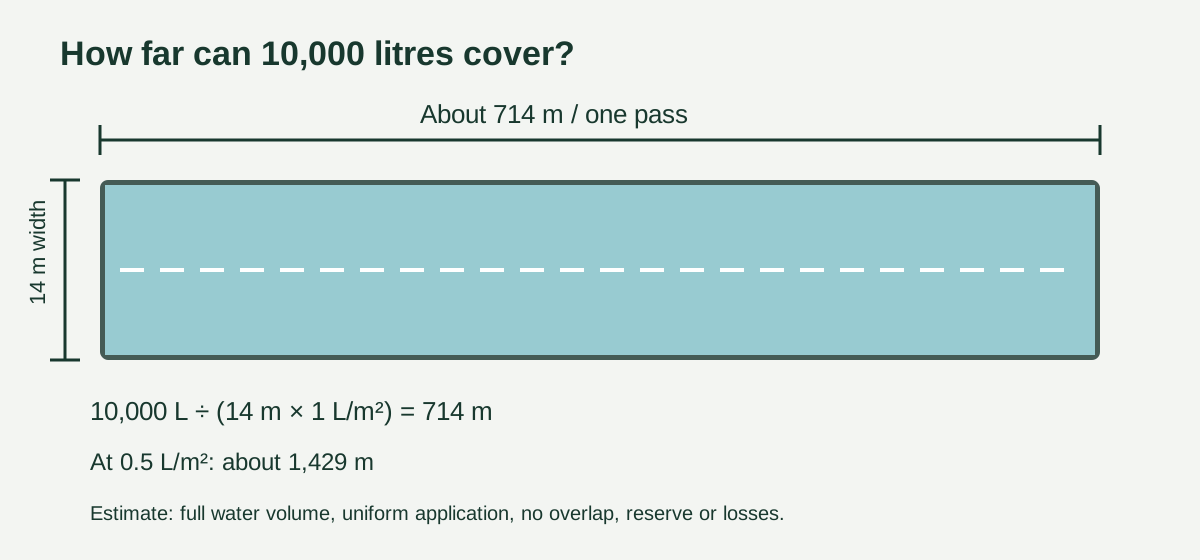
Covered road length (m) = usable water volume (L) ÷ [effective spray width (m) × application rate (L/m²)].
For example: 10,000 ÷ (14 × 1) = 714 m, or approximately 0.7 km. Halving the assumed application rate doubles the calculated distance.
| Tank volume | At 0.5 L/m² | At 1 L/m² |
|---|---|---|
| 5,000 L | About 714 m | About 357 m |
| 7,000 L | About 1,000 m | About 500 m |
| 8,000 L | About 1,143 m | About 571 m |
| 9,380 L | About 1,340 m | About 670 m |
| 12,000 L | About 1,714 m | About 857 m |
| 13,000 L | About 1,857 m | About 929 m |
| 20,000 L | About 2,857 m | About 1,429 m |
Estimates assume a 14 m spray width, one pass and the full tank volume.
For a 10,000 litre water bowser with only 9,000 L available for road application, the estimate falls to about 643 m at 14 m and 1 L/m². Use the volume the completed truck can actually carry and discharge within its rated limits.
To decide how much water for dust control on roads is needed, measure a trial section and the water consumed, then check the result under normal traffic. Surface material, wind, temperature and traffic affect repeat watering. Two passes over the same section consume twice the single-pass volume at the same rate. Record the interval between passes separately from the distance covered.
Which tank size suits different jobs?
These water bowser sizes are starting points for comparing duties.
| Work | Capacity to compare first | What decides the choice |
|---|---|---|
| Urban road washing | 5,000–9,380 L | Tight turns, parked vehicles, cleaning method and nearby refills |
| Road construction | 9,380–13,000 L | Width, daily watering schedule and movement of the work front |
| Mine haul roads | 13,000–20,000 L | Water demand, refill distance, gradients and loaded route limits |
| Landscaping | 5,000–8,000 L | Access to planting areas and hose-based delivery |
| Construction-site water supply | 8,000–20,000 L | Receiving storage, delivery volume and unloading connection |
Road washing may use concentrated front jets rather than uniform full-width spraying, so assess its consumption separately. Landscaping often needs controlled hose delivery at several stops. For site supply, divide the required daily delivery volume by the usable load and round up to estimate loads; then check whether the available shift can accommodate those trips.
If rough access is the main constraint, compare the 8,000 L 4×4 alongside the road-oriented models. Include gradients, surface conditions, turning areas and axle limits in the enquiry.
How many loads can you spray in one day?
Build the cycle from travel, spraying and refilling. Include connection, positioning and queue time where relevant. A larger tank saves refill visits only when those visits are a significant part of the shift.
Consider a hypothetical 10,000 L working load and a water point 5 km from the spray section. Assume 30 km/h average travel speed in both directions, a measured combined discharge of 500 L/min, a refill supply of 1,000 L/min and five minutes for connections and positioning per cycle.
| Cycle component | Calculation | Estimated time |
|---|---|---|
| Travel to road and return | 10 km ÷ 30 km/h × 60 | 20 min |
| Spray one working load | 10,000 L ÷ 500 L/min | 20 min |
| Refill | 10,000 L ÷ 1,000 L/min | 10 min |
| Connections and positioning | Assumed allowance | 5 min |
| Total | 20 + 20 + 10 + 5 | 55 min |
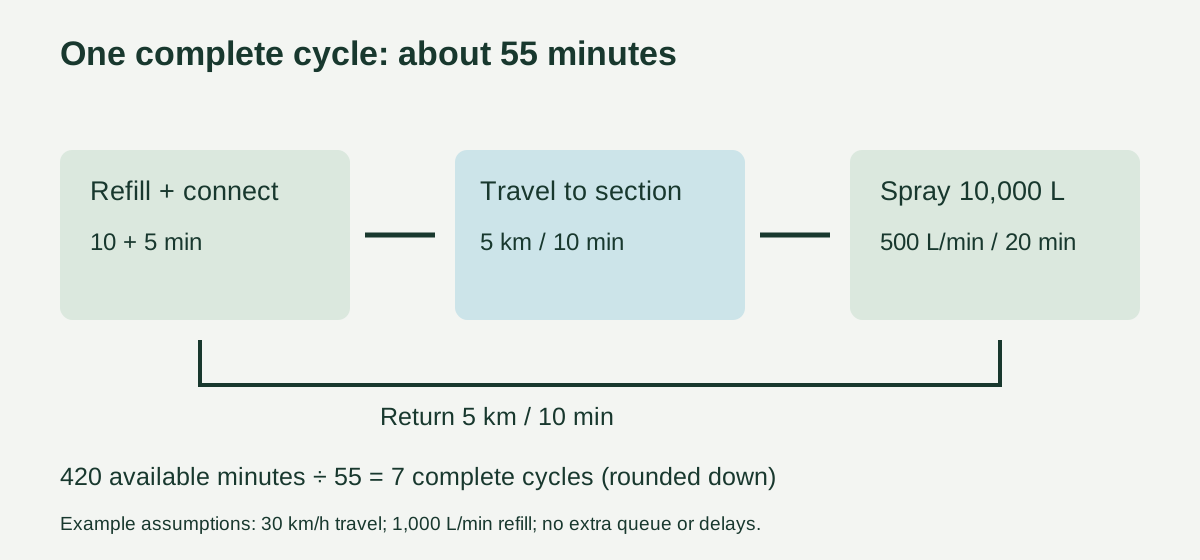
In an eight-hour shift with 60 minutes reserved for breaks, checks and other delays, 420 minutes remain. Round 420 ÷ 55 down to seven complete cycles, equivalent to 70,000 L applied.
At 14 m and 1 L/m², 70,000 L represents about 5 km of single-pass coverage. It may be the same kilometre watered five times.
Plan your water bowser capacity on WhatsApp
Compare the current models and starting prices
Our water bowser range covers seven models:
| Model | Capacity | Chassis and drive | Duty to assess | Starting price |
|---|---|---|---|---|
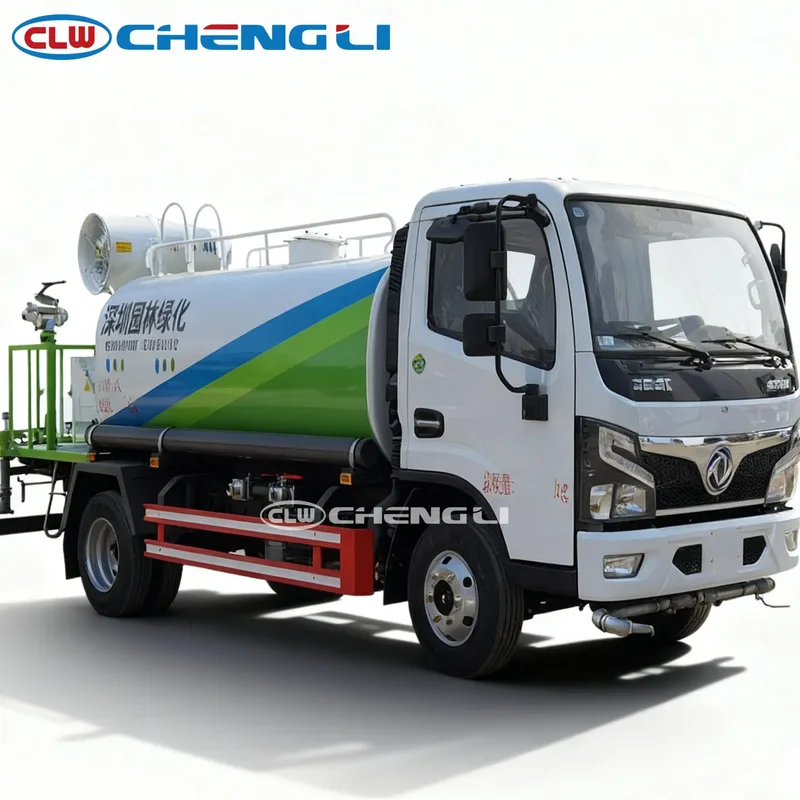 5,000 L Water Bowser Sinotruk HOWO 4×2 |
5,000 L | Sinotruk HOWO 4×2 | Short urban rounds | From USD 28,000 |
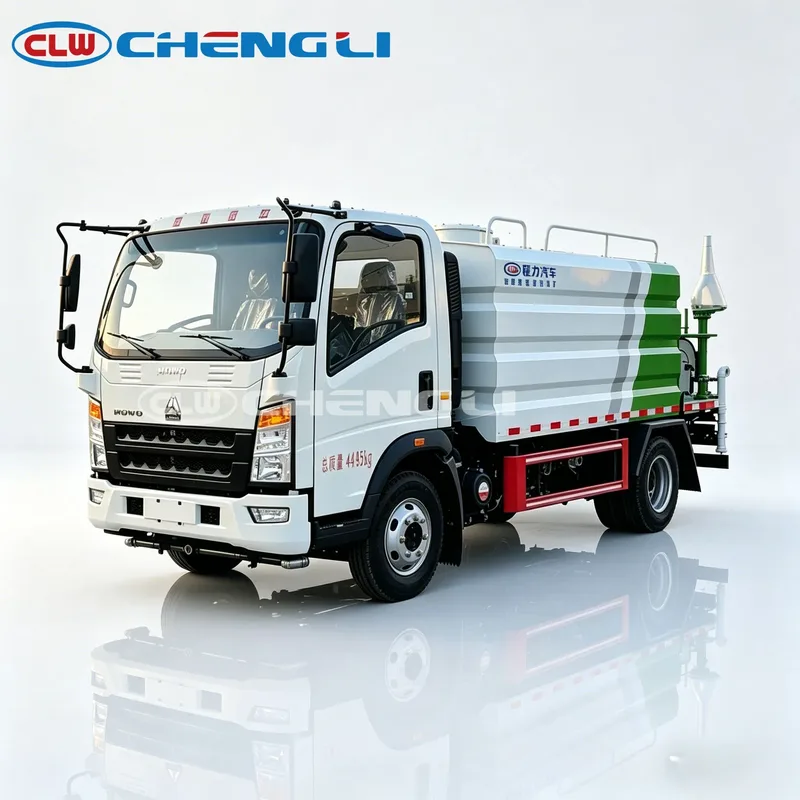 7,000 L Water Bowser Sinotruk HOWO 4×2 |
7,000 L | Sinotruk HOWO 4×2 | Local road watering | From USD 10,800 |
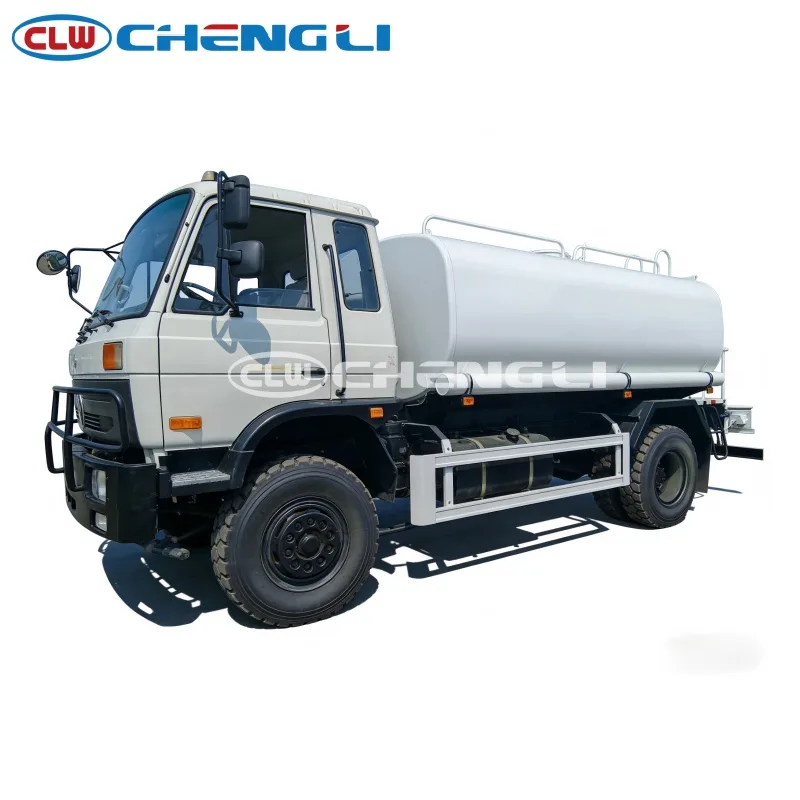 8,000 L Water Bowser 4×4 |
8,000 L | 4×4 | Access-led site work | From USD 38,000 |
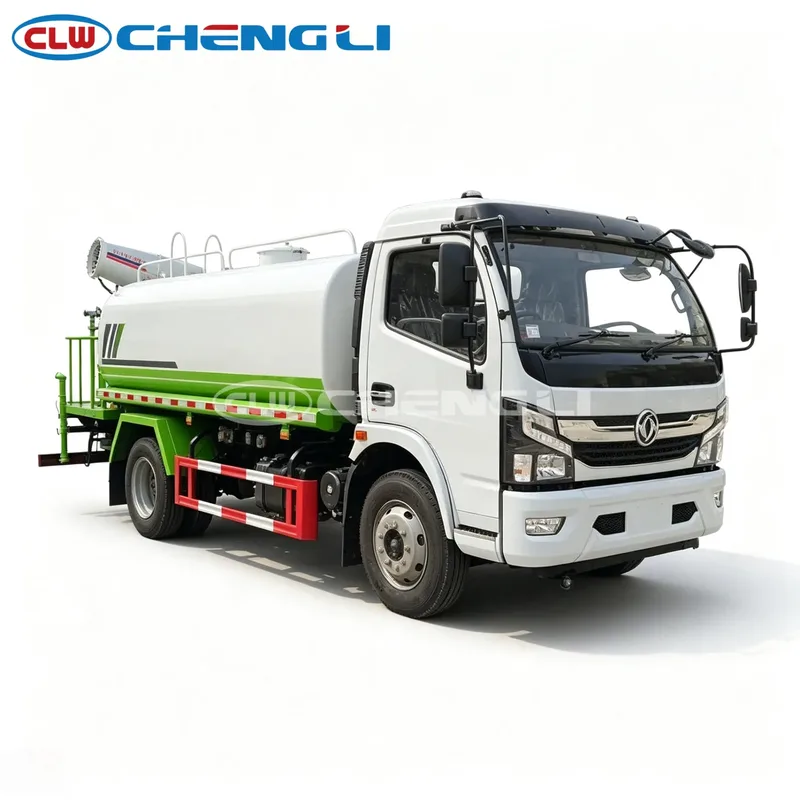 9,380 L Water Bowser Dongfeng 4×2 |
9,380 L | Dongfeng 4×2 | County road schedules | From USD 14,000 |
| Dongfeng D3S 12,000 L Water Bowser for Road Spraying |
12,000 L | Dongfeng 4×2 | Road construction | From USD 16,000 |
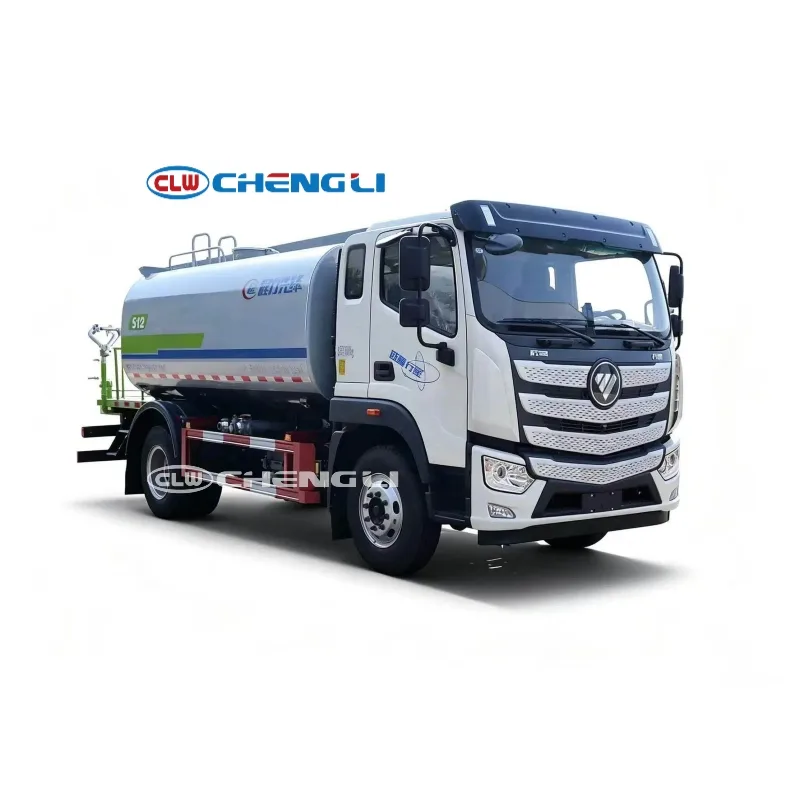 13,000 L Water Bowser Foton 4×2 |
13,000 L | Foton 4×2 | Longer watering rounds | From USD 20,000 |
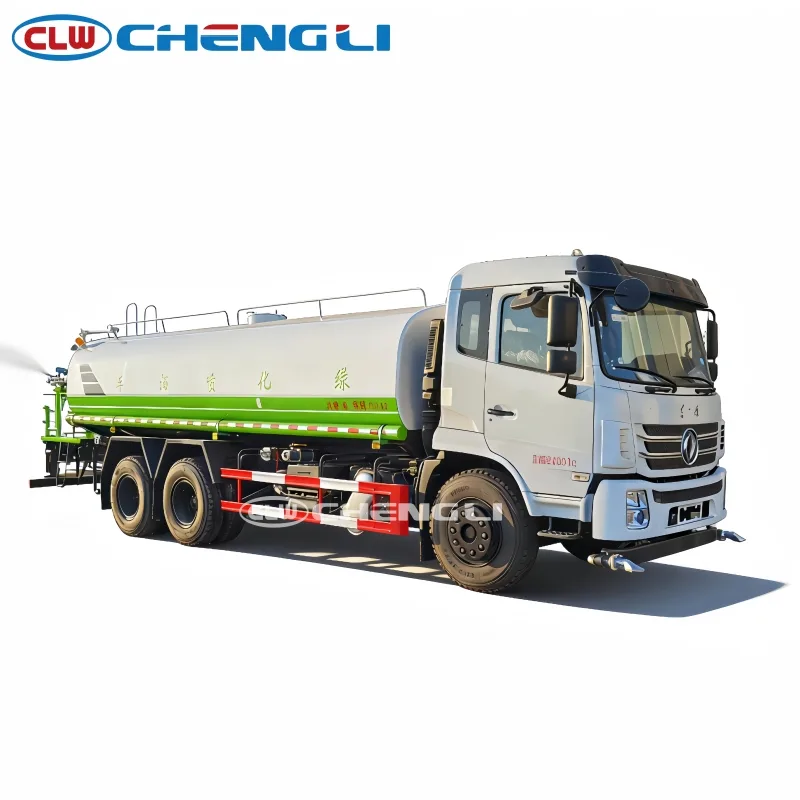 20,000 L Water Bowser Dongfeng 6×4 |
20,000 L | Dongfeng 6×4 | Higher-volume haul roads | From USD 28,000 |
Starting prices are for the base vehicles. Freight, clearance and destination delivery are separate. Compare the selected build before choosing by cost per litre. Browse the water bowser for sale range and check the water bowser price list for the wider vehicle budget.
How spray equipment changes the result
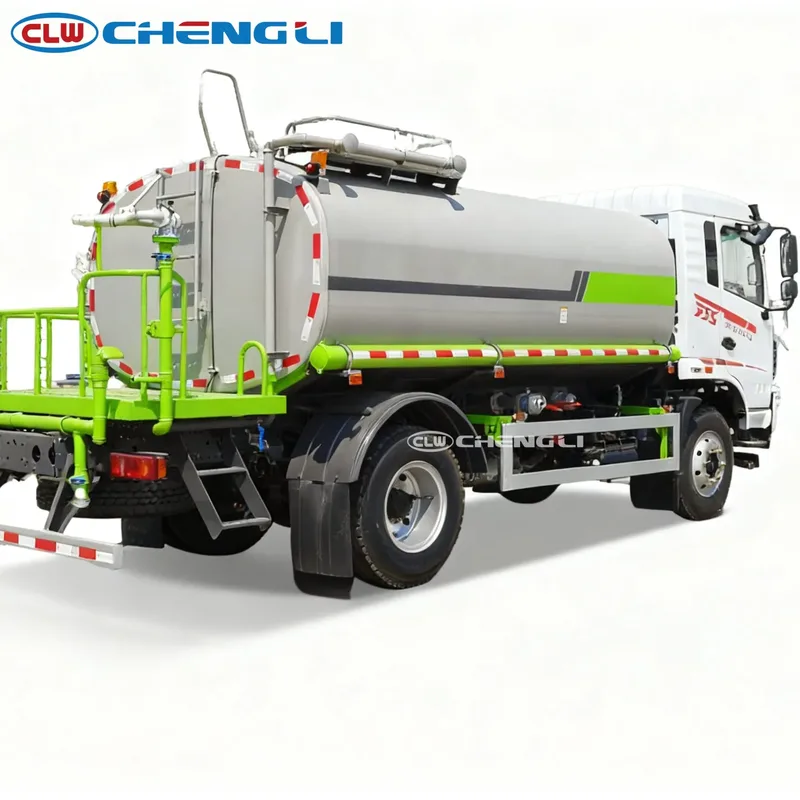
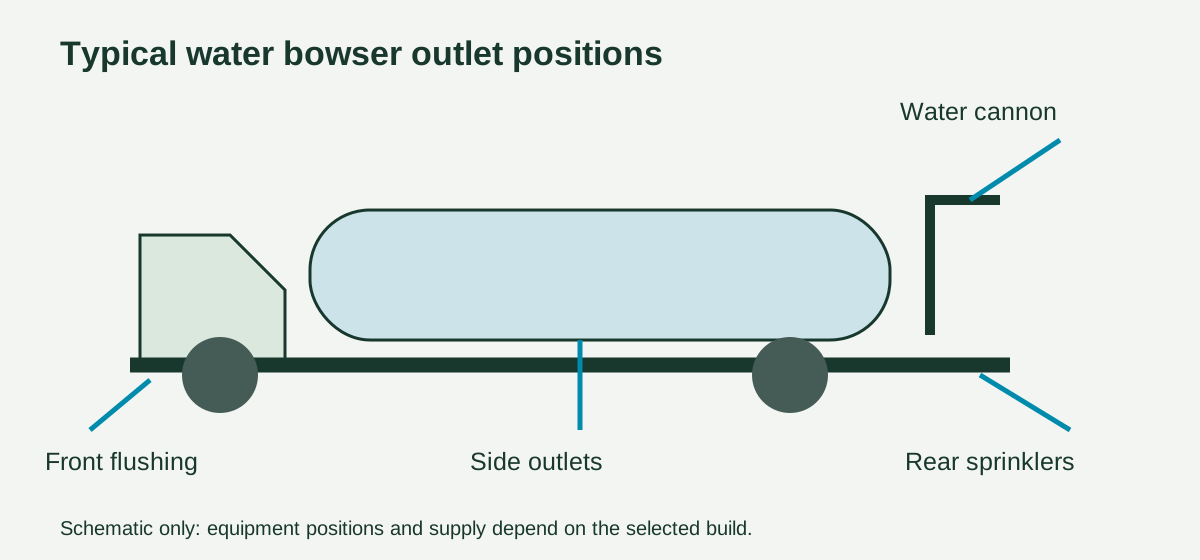
Front flushing jets direct water towards the road ahead for washing. Their effective working strip and consumption can differ from rear sprinklers. Specify whether washing or dust watering is the main task.
Rear sprinklers distribute water behind the truck. Check the usable pattern at the intended operating speed, including overlap between outlets.
Side sprays help reach road edges, verges and planting areas. Opening them alongside the rear outlets increases total water demand and may reduce pressure elsewhere in the circuit.
A water cannon provides a directed stream for a separate task. Include its use in the daily water budget. For long-range misting, compare our Dust Suppression Trucks instead.
The pump and valves determine flow at the selected outlets. The Dongfeng D3S uses a PTO-driven pump. Refill speed also depends on the water supply.
Tank material and internal arrangement should suit the water source and service. Discuss corrosion protection, cleaning access and baffles in the specification. For drinking water, specify a food-grade tank.
| Model | Pump model | Spray width | Spray reach | Tank material | Baffles |
|---|---|---|---|---|---|
| 5,000 L HOWO | 40-50 | ||||
| 7,000 L HOWO | High-strength carbon steel | ||||
| 8,000 L 4×4 | 304 or 316 stainless steel options | ||||
| 9,380 L Dongfeng | ≥30 m | Q235 carbon steel | |||
| 12,000 L Dongfeng D3S | 60-90 (50-110 option) | ||||
| 13,000 L Foton Auman | ≥12 m | ≥28 m | 4 mm carbon steel | 3 mm baffles | |
| 20,000 L Dongfeng | 60-90 (50-110 option) |
Which model fits your job?
County government: start by comparing the 9,380 L Dongfeng 4×2, from USD 14,000, for a mixed road-watering schedule. Check access to neighbourhood streets and how many refills fit between assigned sections.
Road contractor: compare the 12,000 L Dongfeng D3S, from USD 16,000, when the work front needs more water between refills. Send the changing haul distance to water as well as the current road width.
Mine operator: compare the 20,000 L Dongfeng 6×4, from USD 28,000, for higher-volume demand. Confirm the completed truck’s rated load and axle weights before planning around a full tank. Each 1,000 L of water adds approximately one tonne of water load.
Frequently asked questions
How far will a 10,000 L tank go?
About 714 m at 1 L/m² or 1,429 m at 0.5 L/m². See the coverage table for the calculation assumptions.
How often should a gravel road be watered?
Start with a trial section, record how long it stays damp under traffic, and set the interval from that.
Does a bigger tank always mean more work per day?
It can reduce refill trips, but slower loading, access restrictions or a limited water supply may offset the benefit. Compare full cycle times and usable loads.
Can one bowser water roads and supply a site tank?
Yes, when the specified fittings and pump suit both jobs. Include receiving height, hose distance, required flow and the volume reserved for each task in the enquiry.
What details should I send for a recommendation?
Send road width, distance, intended application, repeat schedule, refill distance and supply rate, access conditions, steering requirement, quantity and destination. Include the working shift and any tender specification.
Founded in 2004, Chengli Group has 14 production bases and exports to more than 50 countries and regions. Our seven water bowser models cover 5,000–20,000 L in 4×2, 4×4 and 6×4 layouts. Before dispatch, you can visit the factory, inspect the truck by video or arrange a third-party inspection.
Send your route details on WhatsApp
For a written quote, send us your water bowser requirements. If your fleet also needs on-site refuelling, see our mobile fuel bowser guide.